It's not my Sox in the World Series this year. ("There's always last year," was the word in Red Sox Nation after the ALDS.) But I can't stop watching baseball. The White Sox have proven to be a formidable American League force, even at Minute Maid Park. Could it be another curse broken? Another Year of the Sox, albeit not of the scarlet variety?
All during this series -- imagine it as the series of the Chicago Climate Exchange versus Houston Big Oil -- I'm struck by the tenor of the commercials: the words "conservation," "fuel economy," and "fuel-efficiency" are filling the airwaves through advertising.
Of course, one expects Honda's claim to have the highest efficiency of any auto manufacturer, but then there's the very unlikely GMC, claiming its Envoy Denali has "fuel efficient technology" behind its massive front grille. Now that's be professional grade.
Here's Ford and Chevy duking it out over who provides more fuel economy in a full-size pickup. Then Ford listing its goals for hybrid and ethanol cars and trucks.
And Chevron talking about the future: "innovative technology," "alternatives" and "conservation." That's right, conservation. An oil company calling for conservation. At over $60 a barrel, I guess they can afford it. But it's made for an interesting twist between innings.
I've long thought that if there was money to be made in being green more companies would get on the bandwagon. Maybe we're heading for a tipping point?
And now, back to the game...
Categories: conservation, climate, oil
25 October 2005


15 October 2005
Hurricanes & Climate Change

Color-enhanced Sea Surface Temperature 50 KM Global Analysis,11-14 October 2005. Archived at the National Climatic Data Center.
Last year, four successive hurricanes crisscrossed Florida; this year Katrina, Rita, and Stan have pummeled the Gulf of Mexico region. According to CNN, tropical storm Vince "strengthened briefly to a hurricane, making 2005 officially the second-busiest hurricane season on record." Vince made landfall in Spain, the first time a cyclone has struck that country in recorded history.
Has this hurricane season been stronger than normal? Is global warming to blame? While pinning the blame on global warming for any single extreme weather event is facile, some recent studies do show an alarming rise in the intensity of tropical storms. Intensity is linked to rising sea surface temperatures. It is widely known that such storms gather strength from warm ocean waters; therefore, as ocean temperatures rise it's likely we'll see more storms of greater violence.
In a recent issue of Science, Peter Webster and Judith Curry document a "60 percent jump in major hurricanes with winds of 131 mph or more and a 1-degree increase in the tropical ocean surface temperature." The study claims that category 4 and 5 hurricanes -- the most intense -- have doubled in the tropics in the last 35 years. Nevertheless, they also warn that more study is needed, given how little is known about the patterns of hurricanes throughout history.
Back in August, NOAA experts determined there were optimal conditions for hurricanes this season, including unusually warm ocean surface temperatures and low wind shear. They upgraded their prediction to "11 to 14 tropical storms from now [then] through November, with seven to nine becoming hurricanes." The greatest hurricane season on record was 1933, "when 21 systems reached tropical storm status or greater. The next most violent year was 1995, with 19 storms."
Thus far, CNN reports, 2005 "is one of the fiercest on record, with more than 17 named storms and nine hurricanes." Not all have hit land, but we have seen the results of those that have and it isn’t comforting. This summer also brought us the earliest Category 4 hurricane recorded in the Caribbean, Dennis, which hit Cuba and Haiti before landing in west Florida from 4-11 July.
Not everyone believes there is a link between the violence of this hurricane season and global warming. Last month, Max Mayfield, director of the National Hurricane Center, told a Senate subcommittee that this is part of a natural cycle that began in 1995 and could last another decade. According to Mayfield, this is "driven by the Atlantic Ocean itself along with the atmosphere above it and not enhanced substantially by global warming."
However, Brenda Ekwurzel, a climate scientist with the Union of Concerned Scientists told CNN in September that, "warmer oceans are converting low-grade storms into powerful hurricanes." She said that warm water to a hurricane is "like throwing gasoline on a fire."
While Webster and others feel secure that global warming may not have an impact on hurricane generation "for another 100 years," most agree the debate on the issue is healthy for science, especially if it leads to further study of one of Mother Nature's cruelest aspects.
Categories: climate
07 October 2005
Caring, or A New Conservation Ethic
Over the past several weeks, in the conference centers of Monterey, the wilderness of Yosemite, and the halls of my company's offices in suburban Washington, our talk has been about drawing a closer connection between conservation and people. We've come a long way, but still have miles to go before we can say we've expanded the boundaries of our own conservation ethic.
I've been thinking a lot lately about conservation ethic. One phrase that keeps coming back to me is Robert Michael Pyle's statement that "People who care conserve, people who don't know don't care." It's a powerful truism and one to which we should pay heed. Our movement is often accused of being elitist and defeatist and, frankly, those criticisms are far too often accurate. Beautiful photos of pristine places beg the question, "What about the people?"
(Pyle's words came back to me during tonight's playoff battle of the Sox. It was late in the game, my beloved Red Sox had bases loaded and blew several chances to tie the game or take the lead. Johnny Damon was up, surely ready to play the hero. My nine-year old son, who learned to care about baseball -- and my team -- during the 2003 ALCS, was on tenterhooks: would Damon do it? When the Caveman struck out, stranding three base runners and turning the BoSox into WoeSox once again, my son was apoplectic. "Now I know you are a true fan," I told him. "You really cared." I haven't seen him that upset since he learned that polar bears were losing habitat to global warming!)
We need a new conservation ethic that clearly redefines the human + nature equation: that human beings are not apart from, but rather a part of nature. We need to articulate the real connections between conservation and restoration of the earth's natural functions -- also known as ecosystem services -- and their real implications for the people of the earth. Moreover, that we care about people as much as the earth's other species. Without this, we will sink in a downward spiral of our own making.
Whether we're talking about food, fuel, fiber for clothing or paper or a myriad of other goods and services nature provides, we need to stop "seeing the natural world as a resource for the economy," as James Gustave Speth writes in his book, Red Sky at Morning, "rather than seeing the economy as nested in the natural world."
We have obligations to the world that go beyond our self-interest, to paraphrase Aldo Leopold, and until we own up to this our conservation ethic will ring false for the majority of the world's people. Our new conservation ethic must be as inclusive as it is pragmatic, and as interconnected to the other issues of our time -- poverty alleviation, terrorism, AIDS/HIV -- as to the natural world we hold dear.
We need to remember this whether we're on higher ground in one of this nation's important National Parks, the sterile corridors of an office in northern Virginia, or the cozy confines of that little bandbox of a ballpark that is Fenway.
Categories: conservation, ethic, poverty
I've been thinking a lot lately about conservation ethic. One phrase that keeps coming back to me is Robert Michael Pyle's statement that "People who care conserve, people who don't know don't care." It's a powerful truism and one to which we should pay heed. Our movement is often accused of being elitist and defeatist and, frankly, those criticisms are far too often accurate. Beautiful photos of pristine places beg the question, "What about the people?"
(Pyle's words came back to me during tonight's playoff battle of the Sox. It was late in the game, my beloved Red Sox had bases loaded and blew several chances to tie the game or take the lead. Johnny Damon was up, surely ready to play the hero. My nine-year old son, who learned to care about baseball -- and my team -- during the 2003 ALCS, was on tenterhooks: would Damon do it? When the Caveman struck out, stranding three base runners and turning the BoSox into WoeSox once again, my son was apoplectic. "Now I know you are a true fan," I told him. "You really cared." I haven't seen him that upset since he learned that polar bears were losing habitat to global warming!)
We need a new conservation ethic that clearly redefines the human + nature equation: that human beings are not apart from, but rather a part of nature. We need to articulate the real connections between conservation and restoration of the earth's natural functions -- also known as ecosystem services -- and their real implications for the people of the earth. Moreover, that we care about people as much as the earth's other species. Without this, we will sink in a downward spiral of our own making.
Whether we're talking about food, fuel, fiber for clothing or paper or a myriad of other goods and services nature provides, we need to stop "seeing the natural world as a resource for the economy," as James Gustave Speth writes in his book, Red Sky at Morning, "rather than seeing the economy as nested in the natural world."
We have obligations to the world that go beyond our self-interest, to paraphrase Aldo Leopold, and until we own up to this our conservation ethic will ring false for the majority of the world's people. Our new conservation ethic must be as inclusive as it is pragmatic, and as interconnected to the other issues of our time -- poverty alleviation, terrorism, AIDS/HIV -- as to the natural world we hold dear.
We need to remember this whether we're on higher ground in one of this nation's important National Parks, the sterile corridors of an office in northern Virginia, or the cozy confines of that little bandbox of a ballpark that is Fenway.
Categories: conservation, ethic, poverty
28 September 2005
And the Poor Shall be Rich...
In a meeting I attended last week in Monterey, California, much of the talk centered on ecosystems services and how to account for them, how to factor them into the mix for conservation action, and their impact on the poor.
How curious to note, then, that only the week before, on the floor of the UN, the environment minister of Costa Rica was making similar comments and selling the concept to a group there gathered.
Maybe there is something in the air.
The concept of ecosystem services -- the life-sustaining properties and protection provided by nature -- has been kicking around for more than a decade. Only now, it seems to be getting some traction.
Countries like Costa Rica have unparalleled natural riches; this is undeniable. That we should economically quantify the contribution of such natural services as clean water from watersheds, flood and storm control from coastal wetlands and barrier islands, greenhouse gas reductions from forests and grasslands is not a new idea. But there is a new twist.
Where ecosystems services are concerned, it turns out the poorest are richest.
As The Economist (17 Sept 2005) says, "When natural accounts are expanded to include not only 'produced' wealth (goods and services), but also intangibles (such as knowledge) and especially natural wealth, they reveal some interesting patterns."
Now the World Bank and others, such as Carlos Manuel Rodriguez, that environment minister from Costa Rica, are calling for a new accounting to measure a country's economic welfare, a sort of "Green GDP," in the words of some.
It's been tried before, most notably in the macro-scale by Robert Constanza and other authors of a controversial Nature article a few years ago, but never (to my knowledge) on a country by country basis.
"If all environment ministers abandon tree-hugging in favor of such talk of profit and loss," The Economist notes, "Mr. Rodriguez's dreams may yet come true." That may be a long time coming, maybe too long to outrun the herd.
And there are still many a naysayer in the environmental community who would eschew any such valuing nature. They believe nature has "intrinsic value" and argue we should be altruistic in our efforts and our goals.
Wiser minds than mine have pointed out that "profit trumps altruism" every time. Maybe it's time to cede the bean counters the floor, and give profit a chance. Then the meek shall inherit the true wealth of nations.
Categories: conservation, poverty
How curious to note, then, that only the week before, on the floor of the UN, the environment minister of Costa Rica was making similar comments and selling the concept to a group there gathered.
Maybe there is something in the air.
The concept of ecosystem services -- the life-sustaining properties and protection provided by nature -- has been kicking around for more than a decade. Only now, it seems to be getting some traction.
Countries like Costa Rica have unparalleled natural riches; this is undeniable. That we should economically quantify the contribution of such natural services as clean water from watersheds, flood and storm control from coastal wetlands and barrier islands, greenhouse gas reductions from forests and grasslands is not a new idea. But there is a new twist.
Where ecosystems services are concerned, it turns out the poorest are richest.
As The Economist (17 Sept 2005) says, "When natural accounts are expanded to include not only 'produced' wealth (goods and services), but also intangibles (such as knowledge) and especially natural wealth, they reveal some interesting patterns."
Now the World Bank and others, such as Carlos Manuel Rodriguez, that environment minister from Costa Rica, are calling for a new accounting to measure a country's economic welfare, a sort of "Green GDP," in the words of some.
It's been tried before, most notably in the macro-scale by Robert Constanza and other authors of a controversial Nature article a few years ago, but never (to my knowledge) on a country by country basis.
"If all environment ministers abandon tree-hugging in favor of such talk of profit and loss," The Economist notes, "Mr. Rodriguez's dreams may yet come true." That may be a long time coming, maybe too long to outrun the herd.
And there are still many a naysayer in the environmental community who would eschew any such valuing nature. They believe nature has "intrinsic value" and argue we should be altruistic in our efforts and our goals.
Wiser minds than mine have pointed out that "profit trumps altruism" every time. Maybe it's time to cede the bean counters the floor, and give profit a chance. Then the meek shall inherit the true wealth of nations.
Categories: conservation, poverty
04 September 2005
A Ripple of Hope: Safe Drinking Water
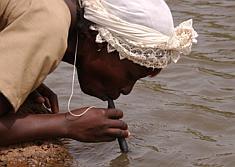
One of the UN Millennium Development Goals is to "reduce by half the proportion of people without sustainable access to safe drinking water" by the year 2015. Currently, more than one billion people do not have access to safe water and about half of the world's poor suffer from waterborne diseases. Over 6,000, mainly children, die each day by consuming unsafe drinking water.
Now a company called Vestergaard Frandsen, with branch offices in many developing countries, is pioneering a new product called the LifeStraw, which aims reduce the impact of waterborne diseases such as typhoid, cholera, dysentery, and diarrhea. The company specializes in disease control textiles and is the creator of the PermaNet, an insecticidal polyester mosquito bed net, and the ZeroFly shelter, an insecticidal plastic sheet that provides both shelter and malaria prevention for extreme emergency situations.
The LifeStraw turns surface water into drinking water as the drinker sucks in water from wherever she may be. Its simplicity is matched only by its effectiveness. It has a lifespan of 700 liters or about one year of water consumption for one person. The cost? The small plastic pipe filter runs around two bucks.
An article in MedGadget, "the internet journal of emerging medical technologies," describes the LifeStraw this way:
"What first meets the water when sucked up is a pre-filter of PE filter textile with a mesh opening of 100 micron, shortly followed by a second textile filter in polyester with a mesh opening of 15 micron. In this way all big articles are filtered out, even clusters of bacteria are removed. Then the water is led into a chamber of iodine impregnated beads, where bacteria, viruses and parasites are killed. The second chamber is a void space, where the iodine being washed off the beads can maintain their killing effect. The last chamber consists of granulated active carbon, which role is to take the main part of the bad smell of iodine, and to take the parasites that have not been taken by the pre-filter or killed by the iodine. The biggest parasites will be taken by the pre-filter, the weakest will be killed by the iodine, and the medium range parasites will be picked up by the active carbon. The main interest to everyone is the killing of bacteria, and here our laboratory reading tells us that we have a log. 7 to log 8 kill of most bacteria. This is better than tap water in many developed countries."
And the LifeStraw does all this for about the cost of a small bottle of "spring water" at your local airport newsstand!
More information: INDEX: The World Arena for Future Design and Innovation
Categories: conservation, water, poverty
03 September 2005
Story Telling as a Conservation Strategy
In the conservation community, when we talk about our work, we talk mostly about bucks and acres. We focus on how much land we protected, the species saved or how much money it took to do the deal.
What we leave behind is the back-story, which has more to do with the human communities affected by our work -- the families and individuals with ties to the lands and waters and the natural, life-sustaining services that provide their livelihood. There is always a story behind the scenes -- beyond the deal -- that is more compelling.
Several years ago, I learned about the work of Peter Forbes, who was spending a year or more as a fellow with his group, the Trust for Public Land. He spent much of that time examining their deals, looking for, and telling the back-stories. He gathered the stories, developing a method for ferreting them out of the muck. The result was The Story Handbook. I talked to Peter about his work several years ago at the annual Land Trust Alliance Rally and found an ally, someone whose thinking on the subject dwarfs mine.
My discipline in the conservation arena is fundraising; I've spent the last 14 years raising money from some wonderful people to protect places we care about together. I wanted to find a practical application for this thinking and a venue to test my assumptions. I'd been leading fundraising workshops for the Pennsylvania Land Trust Association over the years and approached them about an idea for a new workshop.
I called it "Telling Our Story: Connecting Place & People to Inspire Transformational Giving." I lead participants through an exercise in uncovering the back-story and bring it to the foreground. Really, it was about changing the nature of our conversations about conservation. I wanted the conversation to be more about the needs we fulfill, not about needs we have, and about what we can solve and what we can only serve. The idea was to focus on people, their values, and the impact we were having on issues and on people.
The participants had ten minutes to create their story, then pair off and tell it to a partner. Bringing them back together, I shared Forbes's "Story Sheets" concept from the Handbook, pulling out six essential points for a different kind of story telling:
The group then had to redraft their story along these lines, retell the story to their partner and then talk about what changed in their story, whether it was more compelling told in this way. The results were great; people told better stories in this new context. Moreover, their stories were less jargon-riddled and numbers oriented. They told real stories to which others could relate.
I went back to a couple of people in the organization I work for, The Nature Conservancy, and shared this idea. They latched onto it and took it further than I could ever imagine. The next thing I knew, we held a conference for fundraisers devoted to this concept of story telling. Peter Forbes was a keynote speaker and we passed out copies of The Story Handbook as required reading. Then one of our regions adopted the method, instructing their field-based staff in the art of telling their stories in a more personal and compelling way. Beautiful.
I continue to explore this vein, after afflicting the organization with this idea virus of story telling. Most recently, I have worked with a few colleagues to collect stories from the field and from partners and incorporate them into our toolbox for staff. Later this month we will publish a small book for a meeting in Monterey, Saving Our Seas: Stories of Marine Conservation. I'm excited about this effort and hope others will be.
People connect to stories; it is a tradition as old as human communication itself. We are a story telling species. Stories connect people to other people and to the lands and waters we protect. Like the songlines of the Aborigines, stories map a place in a way beyond symbols and geography. Stories are our way of connecting with each other and more broadly with the world. Think about it: when you get together with your friends, do you share stories?
If we're going to build a conservation ethic, we need to share our stories, to nurture a culture of story telling. We need to get at the heart of what makes our work relevant and important to people, to the future of our species and those with whom we share the earth, our island home.
What's your story?
Categories: conservation, stories
What we leave behind is the back-story, which has more to do with the human communities affected by our work -- the families and individuals with ties to the lands and waters and the natural, life-sustaining services that provide their livelihood. There is always a story behind the scenes -- beyond the deal -- that is more compelling.
Several years ago, I learned about the work of Peter Forbes, who was spending a year or more as a fellow with his group, the Trust for Public Land. He spent much of that time examining their deals, looking for, and telling the back-stories. He gathered the stories, developing a method for ferreting them out of the muck. The result was The Story Handbook. I talked to Peter about his work several years ago at the annual Land Trust Alliance Rally and found an ally, someone whose thinking on the subject dwarfs mine.
My discipline in the conservation arena is fundraising; I've spent the last 14 years raising money from some wonderful people to protect places we care about together. I wanted to find a practical application for this thinking and a venue to test my assumptions. I'd been leading fundraising workshops for the Pennsylvania Land Trust Association over the years and approached them about an idea for a new workshop.
I called it "Telling Our Story: Connecting Place & People to Inspire Transformational Giving." I lead participants through an exercise in uncovering the back-story and bring it to the foreground. Really, it was about changing the nature of our conversations about conservation. I wanted the conversation to be more about the needs we fulfill, not about needs we have, and about what we can solve and what we can only serve. The idea was to focus on people, their values, and the impact we were having on issues and on people.
The participants had ten minutes to create their story, then pair off and tell it to a partner. Bringing them back together, I shared Forbes's "Story Sheets" concept from the Handbook, pulling out six essential points for a different kind of story telling:
Describe the place from personal experience
State the context for the conservation project
Broader historical context
Larger Social Good Being Addressed
Relationships Strengthened and Preserved
Convey Emotion and Core Values
The group then had to redraft their story along these lines, retell the story to their partner and then talk about what changed in their story, whether it was more compelling told in this way. The results were great; people told better stories in this new context. Moreover, their stories were less jargon-riddled and numbers oriented. They told real stories to which others could relate.
I went back to a couple of people in the organization I work for, The Nature Conservancy, and shared this idea. They latched onto it and took it further than I could ever imagine. The next thing I knew, we held a conference for fundraisers devoted to this concept of story telling. Peter Forbes was a keynote speaker and we passed out copies of The Story Handbook as required reading. Then one of our regions adopted the method, instructing their field-based staff in the art of telling their stories in a more personal and compelling way. Beautiful.
I continue to explore this vein, after afflicting the organization with this idea virus of story telling. Most recently, I have worked with a few colleagues to collect stories from the field and from partners and incorporate them into our toolbox for staff. Later this month we will publish a small book for a meeting in Monterey, Saving Our Seas: Stories of Marine Conservation. I'm excited about this effort and hope others will be.
People connect to stories; it is a tradition as old as human communication itself. We are a story telling species. Stories connect people to other people and to the lands and waters we protect. Like the songlines of the Aborigines, stories map a place in a way beyond symbols and geography. Stories are our way of connecting with each other and more broadly with the world. Think about it: when you get together with your friends, do you share stories?
If we're going to build a conservation ethic, we need to share our stories, to nurture a culture of story telling. We need to get at the heart of what makes our work relevant and important to people, to the future of our species and those with whom we share the earth, our island home.
What's your story?
Categories: conservation, stories
Subscribe to:
Posts (Atom)