This post originally appeared on The Green Skeptic in March 2008, when I was about to speak at the Aspen Environment Forum. It's reprinted here as I am on hiatus from writing the blog. I promise to be back at it soon. Meanwhile, I hope you enjoy this piece. --Scott
##
Everything we think about saving or protecting ecosystems and habitats is wrong.
This week, I'm at the Aspen Environment Forum, where tomorrow morning I'll be on a Panel called "Nature's Place: Saving Ecosystems and Habitats."
For the better part of 15 years I worked with The Nature Conservancy to save some of the world's "Last Great Places" around the world (I left in August; see my posts reflecting on my career at TNC
and here.
I consider myself a conservationist, not an environmentalist. What I mean by that is a conservative and prudent approach to our use of resources that requires us to manage them for the long-term -- for the benefit of people today and for future generations.
The Green Skeptic grew out of an increasing concern about our relationship to the natural world and how we protect it. I am a skeptic in the sense that I believe we need to constantly challenge the assumptions we have about "saving ecosystems and habitats."
In my view, we operate under four basic assumptions:
1. We can continue to "save" or "protect" ecosystems and habitats from harm in perpetuity;
2. We can ignore basic human needs and treat poverty alleviation as a separate issue from the environment;
3. We can entrust protection to governments and corporate NGOs;
4. We can't trust human ingenuity and community to manage its own resources.
First, I need to step back and look at the words we use. (I am a poet, so words matter to me.) Specifically, "protecting" and "saving."
Both imply we need to keep ecosystems and habitats from something. The American Heritage Dictionary defines protecting as "To keep from being damaged, attacked, stolen, or injured; guard." When we use the word protecting in terms of ecosystems and habitats, we are guarding nature from something or someone, presumably humans.
Saving is a little less problematic, as it implies a conservative approach to the future (as in saving seed corn for next year's sowing). Still, the AHD's first definition is "To rescue from harm, danger, or loss." It's not until definition number three that we get to the conservative impulse: "To avoid spending (e.g. money) so as to keep or accumulate it."
The question is not about what we should save, but how and for what purpose.
Is it hubris to assume we have protected or saved anything? We promote the fact that percentages of ecosystems or habitats are protected, but they continue to be encroached upon -- see the Amazon Rainforest for example.
What have we really saved if massive changes from climate change or the drive for much-needed economic development will have significant impact on the future status and makeup of places, habitats, and ecosystems?
Climate change will disrupt many ecosystems that exist today -- much as the Internet disrupted print media, the travel industry, TV, bookstores, you name it. It will change everything.
So the question is what are we really protecting when we talk about protecting ecosystems and habitat? Will the places we select for protection today be the same 10-20 years from now? Probably not.
Ecosystems are constantly changing, either from "external" (human) or "internal" (natural) forces. Change is inevitable and could, in the face of global warming, be dramatic.
Shouldn't we be preparing for the changes and begin to think about how we adapt to some of the most likely changes, those brought on by climate change or economic development or basic human needs, such as for food and energy?
Demand for energy and food will drive economic development for years to come and we can't continue to ignore these drivers to "save" the natural, non-human world.
This leads me to assumption two, which is about ignoring basic human needs. It's irrational for us to think that people in developing countries, many of whose basic human needs are not being met, will care deeply about the non-human natural world.
Yet, we continue to have blind faith in our cause and ignore the needs of real people.
I recently returned from India where the extreme poverty is evident almost everywhere you look. Also evident is a growing middle class that strives for the kind of lifestyle we have here in the west, specifically the US, with its inherent accelerated pace and impacts.
Who are we to say that people in developing countries have no right to the kind of lifestyle we have exported for decades? We can not convince, persuade or cajole or even pay people -- Americans as much as people in developing nations -- to "come around to our way of thinking," and yet this is what I hear whenever I talk to environmentalists.
And we can't ask poor people around the world to forgo the comforts of the lifestyle we have been living, and which they wish to copy, "for the sake of the planet" or to set aside their habitats and ecosystems for the sake of humanity. No country wants to become an ecological reserve for the world, especially if it means it cannot pursue economic prosperity.
Try floating this idea with people who go hungry every night for lack of food or money to buy food and see what kind of reaction you get.
In the end, poor people matter. And the governments of Brazil, China, India, Indonesia and African countries must be concerned first and foremost with the well-being of their people. I'm not saying that human well-being isn't tied to ecosystem health; I'm a strong believer that economic growth is tied to those resources.
I believe we can no longer separate the issue of economic development and poverty alleviation from ecosystem health. We also can't expect that governments whose people aren't meeting basic needs to protect their habitats over the economic well-being of their people.
Which leads me to assumption three: increasingly, we are entrusting protection of habitats and ecosystems with the wrong people. Governments have a mandate to improve the economic health of their country and people.
Yet we continue to have faith that these governments will "do the right thing" and enforce laws protecting their forests or other ecosystems in the face of seemingly insurmountable economic obstacles.
Why do we think that is a good strategy? What indicators do we have that tell us this strategy will succeed where it hasn't in the past? Why do we think that the World Bank program to pay countries to "avoid deforestation" will be any more successful than their previous grand plans?
The same goes for NGOs. NGOs are basically corporations that serve a set of shareholders (donors in this case) who subscribe to a specific idea of Nature and a specific set of outcomes, outcomes that may not necessarily be shared by all stakeholders.
This idea of Nature has for a long time discounted the needs of people both today and in the future. To illustrate this, one only need look at the environmental community's approach to government debt.
Conservation groups (my old employers among them) have promoted using a country's debt as leverage to gain conservation protection. The debt-for-nature swap was an innovation of the past couple of decades and a noble one. But it was also painfully ignorant of the true nature of that debt -- in many cases "dictator debt" incurred by regimes that did not have its people's best interests in mind.
Now that we have a more clear understanding of how that debt was derived, and can no longer ignore its immoral origins, we need to give up or adjust the debt-for-nature swap concept and join the call for debt forgiveness. That will free some countries from having to exploit their natural resources to pay down that debt.
Yet, many in the environmental community continue to push the debt-for-nature strategy, because they can't let go of a good thing that advances their agenda.
How is this different from any corporation -- a sector many environmentalists attack -- that advances its agenda at the expense of people here and abroad? Can we really trust ecosystems and habitats to big government or big international non-governmental corporations?
In the end, wouldn't a better approach be to put our trust in the people and the communities where these ecosystems and habitats are found? They have the most at stake in managing these resources, as their needs and livelihoods are most closely tied to the lands and waters.
I believe human beings are basically good. I also believe that, given the opportunity, communities will manage their common interests and keep each other in check. This is the open-source community approach one finds in social networks and in business models such as eBay.
I also believe that human beings are the most creative and adaptable species on the planet -- just look at the variety of habitats, climates, and conditions we inhabit. Our resilience as a species is astounding. I argue that we need to embrace this resourcefulness and apply it to overcoming ecological shifts, climate change, and loss of ecosystems and habitats.
We need to unleash the power of human creativity to find new ways to "save" those places for future use by both human and non-human species.
Unleashing this human capacity will require suspending our assumptions. We will need to focus more on community-based or "commons-based" management (as Jonathan Rowe of the West Marin Commons in California calls it in a recent essay in The State of the World 2008).
We need a people-centered conservation that addresses the real needs of real people, and to empower individual entrepreneurs and communities to manage their resources cooperatively rather than impose grand plans from Washington.
We need to clearly draw the lines connecting economic prosperity with ecological health and human well-being.
And, finally, we need to unleash human creativity to find new technological solutions as well as new ways of living with nature.
This may, in the end, be our only hope to really save habitat and ecosystems – and, ultimately, to save ourselves.
Showing posts with label Aspen Environment Forum. Show all posts
Showing posts with label Aspen Environment Forum. Show all posts
10 January 2012
03 August 2009
KVA & Portable Light's Sheila Kennedy on Clean Energy Solutions
 Back in March at the Aspen Environment Forum, I facilitated a panel called Energy Equity: Clean Energy for All, in which we discussed exciting new alternative energy innovations with the potential to change the lives of the "bottom billion" of the world's poor.
One of our panelists, Sheila Kennedy of KVA Kennedy & Violich Architects and the Portable Light Project, shared her designs for textiles with flexible solar materials and solid state lighting that enables people to create energy harvesting bags, blankets, and clothing using local materials and traditional weaving and sewing techniques in an open source model.
Tonight, Sheila will share her latest developments on the show "Brink," on CBS Science Channel.
"At the Aspen Forum, our discussions revolved around what we can do right now to rethink the delivery model for clean energy so it can become more widespread, accessible and enjoyable as a part of everyday life," Sheila wrote to me recently. "It's my hope that our designs can set a new direction for 'ready out of the box' clean energy products and building components that can drive the green economy —- in the developing world and right here at home."
KVA's work with energy harvesting textiles is being featured on a special episode of Brink on "Sustainable Living" tonight at 10:30 PM EST: "Brink"
 Reblog this post [with Zemanta]">

28 March 2009
My Three Take-Aways from Aspen Environment Forum 2009
As the Aspen Environment Forum 2009 winds down, I am reflecting upon my three take-aways from the conference:
1) China will stay on the Green Path and it is essential that US and China find ways to cooperate on Climate Change, Clean Tech (hybrid electric cars), and Carbon Capture and Storage.
2) Confirmed my opinion that the real game-changing technologies and innovations are not going to come from the big, dinosaur players in industry or environment, but from the small, disruptive companies.
3) We have a tremendous opportunity with Dr. Jane Lubchenco at the helm of NOAA to get some more rigor and pragmatism to the debate on climate change impacts, mitigation, and adaptation.
Fantastic final day at AEF09.
1) China will stay on the Green Path and it is essential that US and China find ways to cooperate on Climate Change, Clean Tech (hybrid electric cars), and Carbon Capture and Storage.
2) Confirmed my opinion that the real game-changing technologies and innovations are not going to come from the big, dinosaur players in industry or environment, but from the small, disruptive companies.
3) We have a tremendous opportunity with Dr. Jane Lubchenco at the helm of NOAA to get some more rigor and pragmatism to the debate on climate change impacts, mitigation, and adaptation.
Fantastic final day at AEF09.
Aspen Environment Forum: Powering the Planet: Energy for the Long Run
 Those of you who follow me on Twitter know that I've been at the 2nd Aspen Environment Forum (AEF) this week. Like the Aspen Institute's Ideas Festival, the AEF is an unusual confluence of individuals from a variety of sectors gathered together for, well, conversation.
I like this conference because of its mix of business people, NGO wonks, scientists, writers and artists, a smattering of government types, investors, and residents of Aspen. There are always intriguing synergies that develop when you pull together such a mix, and there are too few conferences that do it so well.
This year's dialogue is focused on energy and, ostensibly we're here to consider the world's needs, the alternative solutions, and the related environmental impacts or benefits.
But as much as I enjoy this conference, I'm also a little frustrated by it.
Throughout the conference, two things have struck me as problematic and perhaps in need of being addressed next year: a noted absence of conflict and a disconnect between some of the advertised topics and the sessions as conducted.
On the first point, I think conflict is essential to generate new ideas and creaitvity. It's been far too congenial here. There were notable exceptions, including a little skirmish between Patrick Moore and James Woolsey over the merits of solar vs. nuclear; and what I understand was an entertaining debate by Randy Udall and Jim Rogers of Duke Energy. (See Karl Burkart's coverage of the latter exchange.)
At least in the sessions I've attended, there has been a little false advertising. One example is yesterday's session on "Environment and Energy: Perspectives from Emerging Economies," which featured some very powerful women, including Queen Noor al Hussein and Alicia Antonio de Abreu from Mozambique.
While I agree that energy and environment issues affect women disproportionately and in often adverse ways, the discussion quickly shifted from the advertised topic to a dialogue on gender equity. Now, don't get me wrong, that's a good topic for discussion, but not what most of us in the room came to participate in.
Even more frustrating was the session on "Environment and New Media." Of the panelists, only Joel Makower (founder of Greener World Media and its related online publications, one of which I have written for in the past) could really be considered part of the "New Media." The others, including Douglas Fischer of The Daily Climate and Margie Kriz of National Journal, were decidedly "old media" and proud of it.
The panelists spent much of the time wringing their hands about the decline of newspapers and other print media. They also trashed bloggers as opinionated yahoos who don't practice journalism and are forcing the old media stalwarts to adapt to changing customer habits and needs, which might lead them to give up journalism and become news aggregators.
In other words, it felt like a wake for old media rather than a substantive discussion about the merits or drawbacks of new media. (To be fair, Chip Giller of Grist.org was originally scheduled to be on this panel, but weather kept him away. He may have added a different tone to the dialogue.)
And it was solely focused on news/journalism and delivery. Where was the dialogue on mobile apps, social networks, and other new media? A missed opportunity.
Engaging the speakers and moderators in developing the overall theme and designing individual sessions may help in future conferences.
Among the highlights of this year's conference: Dr. Jane Lubchenco's conversation with the Washington Post's Juliet Eilperin. We are very lucky to have Dr. Lubchenco at the helm of NOAA; she is a brilliant scientist with a unique ability among brilliant scientists to communicate effectively to a general audience.
There was also better international representation this year, with people from several African countries, Latin America, the Indian sub-continent, the Middle East, and China.
I'm hopeful that today's program, which includes dialogues on conservation, energy efficiency, the Arctic, and China, will be focused and stimulating.
![Reblog this post [with Zemanta]](https://lh3.googleusercontent.com/blogger_img_proxy/AEn0k_urXK5kyrFKqlwj034c3wf6PL_p1riTfPzIzOlTsWXgmEJqR1Tm4gy1pZobjTcJqoqmic-Zl3elL7qmAG3BtMh3PbXeh6SLlw1WVvIT2qGj1PiYxpKzsy0Y5OQq1HOAiOVV59pAWYcR5Y6WVwZWC75N=s0-d)
24 December 2008
An Email from Santa, the Not So Jolly Old Elf
Two Christmases ago, I published this email from Santa, which arrived on the night before the night before Christmas. Readers had so much fun with it, I thought we'd share it again.
Enjoy! And Have a Happy Holiday.
Scott, aka The Green Skeptic
----------------------------
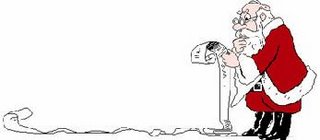
I received this email from Jolly, or not so Jolly St. Nick tonight:
TO: Global Warming Skeptics
FROM: Santa Claus
DATE: A few nights before Xmas
SUBJECT: My Christmas List
________________________________________________
This is Santa, writing from the North Pole. Soon I'll be gathering all the toys for all the good little girls and boys and packing them in my sleigh to begin our journey, our night of nights.
The reindeer, however, are starting to complain about hoof-rot. Apparently, they've been standing around in too much slush. This has put me in a decidedly prickly mood this Christmas.
You know me; I'm not a single-issue guy. I believe that as long as you are good, and I mean good for goodness' sake, you deserve some slack on the other stuff. I'm an equal opportunity distributor. I know whether you've been bad or good or just plain evil. You also know I'm not one to discriminate against one group of people or another, believers or non-believers.
But this year is different. This year, I'm making a few changes to my list. I'm checking it twice and have decided that the naughty include any one of you out there who do not believe in global warming. All you climate change skeptics out there, you are on the naughty list this year.
Oh, you know who you are. And I've got one special gift for you: Nothing but COAL. You like the stuff so much -- and it's such a big part of what's leading to climate change -- you might as well have bags and bags of it and nothing more.
Make no mistake. Global warming is happening. You don't have to show me any scientific reports, although some nifty ones have shown up in my email box lately, sent to me from the National Center for Atmospheric Research and the National Snow and Ice Data Center.
No, you don't have to convince me; I'm a believer. All I have to do is look out my window to my back yard, what's left of it! It's a soupy mess out there.
We usually have a good bit of ice up here at the North Pole -- and early. That's important, too; you see, every year the elves and I construct a temporary workshop up here where we make the toys and assemble the other goodies. The earlier the ice, the sooner we get started.
Although I have figured out a way to deliver the entire shipment of gifts on my list in one night, I still haven't perfected the manufacturing process. I can't speed it up. (Some of that I blame on the unions.) We need all the ice we can get up here for there is no solid ground.
But this year, the ice cover was the lowest it's been in almost 30 years. And at least one of those science groups studying this stuff tells me that, according to their models, by 2040, we'll have mostly open water up here. (They sent me this short animation clip, which sends chills up my spine: Arctic Ice Melt.)
Mrs. Claus has even started looking for Houseboats on Craig's List!
So, dear boys and girls, you better not pout or cry or whine or deny climate change any longer. And I'm telling you why: because climate change is coming to town. Time's a wasting. We need to do something about this now, before it's too late. Or before I have to move all of my operations to the South Pole!
Here's wishing a carbon-neutral Christmas to all, and to all a good night.
S. Claus, North Pole
![Reblog this post [with Zemanta]](https://lh3.googleusercontent.com/blogger_img_proxy/AEn0k_vynaYxv7di1OlHkbAQHHudFMGpnDHPm-5oVyhSnmSYX6TJiPUbXyXArt1_4x-Qb3RCShg30k-5sIGCY2zMKX0cK7uvukoErAGT-SZh-zKppIW-Fw9pmiloIFT6zb0EU1BOoocrwQdytUWB3lk1EHw=s0-d)
Enjoy! And Have a Happy Holiday.
Scott, aka The Green Skeptic
----------------------------

I received this email from Jolly, or not so Jolly St. Nick tonight:
TO: Global Warming Skeptics
FROM: Santa Claus
DATE: A few nights before Xmas
SUBJECT: My Christmas List
________________________________________________
This is Santa, writing from the North Pole. Soon I'll be gathering all the toys for all the good little girls and boys and packing them in my sleigh to begin our journey, our night of nights.
The reindeer, however, are starting to complain about hoof-rot. Apparently, they've been standing around in too much slush. This has put me in a decidedly prickly mood this Christmas.
You know me; I'm not a single-issue guy. I believe that as long as you are good, and I mean good for goodness' sake, you deserve some slack on the other stuff. I'm an equal opportunity distributor. I know whether you've been bad or good or just plain evil. You also know I'm not one to discriminate against one group of people or another, believers or non-believers.
But this year is different. This year, I'm making a few changes to my list. I'm checking it twice and have decided that the naughty include any one of you out there who do not believe in global warming. All you climate change skeptics out there, you are on the naughty list this year.
Oh, you know who you are. And I've got one special gift for you: Nothing but COAL. You like the stuff so much -- and it's such a big part of what's leading to climate change -- you might as well have bags and bags of it and nothing more.
Make no mistake. Global warming is happening. You don't have to show me any scientific reports, although some nifty ones have shown up in my email box lately, sent to me from the National Center for Atmospheric Research and the National Snow and Ice Data Center.
No, you don't have to convince me; I'm a believer. All I have to do is look out my window to my back yard, what's left of it! It's a soupy mess out there.
We usually have a good bit of ice up here at the North Pole -- and early. That's important, too; you see, every year the elves and I construct a temporary workshop up here where we make the toys and assemble the other goodies. The earlier the ice, the sooner we get started.
Although I have figured out a way to deliver the entire shipment of gifts on my list in one night, I still haven't perfected the manufacturing process. I can't speed it up. (Some of that I blame on the unions.) We need all the ice we can get up here for there is no solid ground.
But this year, the ice cover was the lowest it's been in almost 30 years. And at least one of those science groups studying this stuff tells me that, according to their models, by 2040, we'll have mostly open water up here. (They sent me this short animation clip, which sends chills up my spine: Arctic Ice Melt.)
Mrs. Claus has even started looking for Houseboats on Craig's List!
So, dear boys and girls, you better not pout or cry or whine or deny climate change any longer. And I'm telling you why: because climate change is coming to town. Time's a wasting. We need to do something about this now, before it's too late. Or before I have to move all of my operations to the South Pole!
Here's wishing a carbon-neutral Christmas to all, and to all a good night.
S. Claus, North Pole
01 April 2008
Aspen Environment Forum: My Three Take-Aways
Many years ago, someone offered me a piece of advice when I was suffering from information overload at a conference: don't try to absorb or act on everything; just make sure to write down your "3 Take-Aways" before you leave.
This approach has worked out pretty well for me over the years, and last week I dispatched this piece of advice to a young participant of this year's Aspen Environment Forum.
Then I took my own advice. So, here are my 3 Take-Aways from the Forum:
1. There is much to be done and we need all energy options (and plenty of patience) to make progress and ensure prosperity.
2. There are plenty of solutions and plenty of opportunities, but the window to act is now (especially regarding energy efficiency, alternative energy technology, and along the value chain).
3. The New Green Economy needs to be inclusive, especially mobilizing training and redeployment opportunities for disadvantaged and poor people in stressed communities -- to move from pollution and prison culture to solution and social uplift environmentalism.
That seems like a lot, but really one flows to the next. We can do this if we just get our butts in gear. What are we waiting for?
And, I don't remember who you were, but if you're out there, thanks for the good advice!
This approach has worked out pretty well for me over the years, and last week I dispatched this piece of advice to a young participant of this year's Aspen Environment Forum.
Then I took my own advice. So, here are my 3 Take-Aways from the Forum:
1. There is much to be done and we need all energy options (and plenty of patience) to make progress and ensure prosperity.
2. There are plenty of solutions and plenty of opportunities, but the window to act is now (especially regarding energy efficiency, alternative energy technology, and along the value chain).
3. The New Green Economy needs to be inclusive, especially mobilizing training and redeployment opportunities for disadvantaged and poor people in stressed communities -- to move from pollution and prison culture to solution and social uplift environmentalism.
That seems like a lot, but really one flows to the next. We can do this if we just get our butts in gear. What are we waiting for?
And, I don't remember who you were, but if you're out there, thanks for the good advice!
31 March 2008
Innovation: "Green Pathways Out of Poverty," Jones Tells Aspen Environment Forum

The Green Skeptic likes to talk about the New Green Economy. For a long time, I've been nattering on about how America needs to get its act together and seize the opportunity of the a new, greener economy. We snooze; we lose.
China, India, even old rivals Japan and Germany, are poised to take the lead in every major part of clean tech and alternative energy development.
What's at stake? Plenty. Only a multibillion, some say, multitrillion dollar business opportunity.
But at the Aspen Environment Forum last Saturday, Van Jones and Majora Carter reminded us what else is at stake -- and what seizing this opportunity could mean for America.
It could mean, to paraphrase Van Jones, founder of the Ella Baker Center for Human Rights, moving from an economy of pollution and incarceration to one of solutions and green jobs.
Jones, along with Majora Carter, founder of Sustainable South Bronx, called on the crowd -- and are calling on the rest of America too -- to help them launch "Green for All," a kind of green job corps for those currently left on the margins.
"FDR had the Civilian Conservation Corps, with young people going all over America to enhance and build parks," Jones told the crowd in Aspen. "JFK had the Peace Corps, and Clinton had AmeriCorps. It's time we had a Green Job Corps."
The green-collar job sector is growing in the United States and could include more than 14 million workers by 2017 industry, according to some analysts.
The American Solar Energy Society says there are there are potentially 8.5 million U.S. jobs that can be considered "green." That figure could grow by 5 million in the next 10 years, Jerome Ringo of the Apollo Alliance told Steven Greenhouse of The New York Times in an article last week.
Green-collar jobs include "Ph.D.'s and Ph.-do's," said Jones. "We need people who are highly educated at the theoretical level and we need people who are highly educated at the level of skilled labor."
At least 28 US states have chartered mandates pushing for renewable energy to be 10 to 25 percent of their energy portfolio over the next few decades.
"The development of a green economy creates a broad new set of opportunities," Lois Quam, managing director for alternative investments at Piper Jaffray, told the Times.
"When I first started looking at this area," Quam said. "Many people commented on how this will be as big as the Internet. But this is so much bigger than the Internet. The only comparable example we can find is the Industrial Revolution. It will affect every business and every industry."
Jones calls such jobs "green pathways out of poverty."
"Right now we don't have the infrastructure to train a sufficient number of green-collar workers," Jones told the Times. "If we are going to weatherize buildings, they have to be weatherized here. If you put up solar panels, you can't ship a building to Asia and have them put the solar panels on and ship it back. These jobs have to be done in the United States."
Read the Times article: Green Jobs
Check out the "Green For All" presentation from the Aspen Environment Forum 2008: (Clip 1) with Majora Carter, Van Jones. Watch video.
(Clip 2) Watch video.
(Clip 3) Watch video.
28 March 2008
Conservation: What We Talk About When We Talk About Protecting and Saving Ecosystems and Habitats
Everything we think about saving or protecting ecosystems and habitats is wrong.
This week, I'm at the Aspen Environment Forum, where tomorrow morning I'll be on a Panel called "Nature's Place: Saving Ecosystems and Habitats."
For the better part of 15 years I worked with The Nature Conservancy to save some of the world's "Last Great Places" around the world (I left in August; see my posts reflecting on my career at TNC).
I consider myself a conservationist, not an environmentalist. What I mean by that is a conservative and prudent approach to our use of resources that requires us to manage them for the long-term -- for the benefit of people today and for future generations.
The Green Skeptic grew out of an increasing concern about our relationship to the natural world and how we protect it. I am a skeptic in the sense that I believe we need to constantly challenge the assumptions we have about "saving ecosystems and habitats."
In my view, we operate under four basic assumptions:
1. We can continue to "save" or "protect" ecosystems and habitats from harm in perpetuity;
2. We can ignore basic human needs and treat poverty alleviation as a separate issue from the environment;
3. We can entrust protection to governments and corporate NGOs;
4. We can't trust human ingenuity and community to manage its own resources.
First, I need to step back and look at the words we use. (I am a poet, so words matter to me.) Specifically, "protecting" and "saving."
Both imply we need to keep ecosystems and habitats from something. The American Heritage Dictionary defines protecting as "To keep from being damaged, attacked, stolen, or injured; guard." When we use the word protecting in terms of ecosystems and habitats, we are guarding nature from something or someone, presumably humans.
Saving is a little less problematic, as it implies a conservative approach to the future (as in saving seed corn for next year's sowing). Still, the AHD's first definition is "To rescue from harm, danger, or loss." It's not until definition number three that we get to the conservative impulse: "To avoid spending (e.g. money) so as to keep or accumulate it."
The question is not about what we should save, but how and for what purpose.
Is it hubris to assume we have protected or saved anything? We promote the fact that percentages of ecosystems or habitats are protected, but they continue to be encroached upon -- see the Amazon Rainforest for example.
What have we really saved if massive changes from climate change or the drive for much-needed economic development will have significant impact on the future status and makeup of places, habitats, and ecosystems?
Climate change will disrupt many ecosystems that exist today -- much as the Internet disrupted print media, the travel industry, TV, bookstores, you name it. It will change everything.
So the question is what are we really protecting when we talk about protecting ecosystems and habitat? Will the places we select for protection today be the same 10-20 years from now? Probably not.
Ecosystems are constantly changing, either from "external" (human) or "internal" (natural) forces. Change is inevitable and could, in the face of global warming, be dramatic.
Shouldn't we be preparing for the changes and begin to think about how we adapt to some of the most likely changes, those brought on by climate change or economic development or basic human needs, such as for food and energy?
Demand for energy and food will drive economic development for years to come and we can't continue to ignore these drivers to "save" the natural, non-human world.
This leads me to assumption two, which is about ignoring basic human needs. It's irrational for us to think that people in developing countries, many of whose basic human needs are not being met, will care deeply about the non-human natural world.
Yet, we continue to have blind faith in our cause and ignore the needs of real people.
I recently returned from India where the extreme poverty is evident almost everywhere you look. Also evident is a growing middle class that strives for the kind of lifestyle we have here in the west, specifically the US, with its inherent accelerated pace and impacts.
Who are we to say that people in developing countries have no right to the kind of lifestyle we have exported for decades? We can not convince, persuade or cajole or even pay people -- Americans as much as people in developing nations -- to "come around to our way of thinking," and yet this is what I hear whenever I talk to environmentalists.
And we can't ask poor people around the world to forgo the comforts of the lifestyle we have been living, and which they wish to copy, "for the sake of the planet" or to set aside their habitats and ecosystems for the sake of humanity. No country wants to become an ecological reserve for the world, especially if it means it cannot pursue economic prosperity.
Try floating this idea with people who go hungry every night for lack of food or money to buy food and see what kind of reaction you get.
In the end, poor people matter. And the governments of Brazil, China, India, Indonesia and African countries must be concerned first and foremost with the well-being of their people. I'm not saying that human well-being isn't tied to ecosystem health; I'm a strong believer that economic growth is tied to those resources.
I believe we can no longer separate the issue of economic development and poverty alleviation from ecosystem health. We also can't expect that governments whose people aren't meeting basic needs to protect their habitats over the economic well-being of their people.
Which leads me to assumption three: increasingly, we are entrusting protection of habitats and ecosystems with the wrong people. Governments have a mandate to improve the economic health of their country and people.
Yet we continue to have faith that these governments will "do the right thing" and enforce laws protecting their forests or other ecosystems in the face of seemingly insurmountable economic obstacles.
Why do we think that is a good strategy? What indicators do we have that tell us this strategy will succeed where it hasn't in the past? Why do we think that the World Bank program to pay countries to "avoid deforestation" will be any more successful than their previous grand plans?
The same goes for NGOs. NGOs are basically corporations that serve a set of shareholders (donors in this case) who subscribe to a specific idea of Nature and a specific set of outcomes, outcomes that may not necessarily be shared by all stakeholders.
This idea of Nature has for a long time discounted the needs of people both today and in the future. To illustrate this, one only need look at the environmental community's approach to government debt.
Conservation groups (my old employers among them) have promoted using a country's debt as leverage to gain conservation protection. The debt-for-nature swap was an innovation of the past couple of decades and a noble one. But it was also painfully ignorant of the true nature of that debt -- in many cases "dictator debt" incurred by regimes that did not have its people's best interests in mind.
Now that we have a more clear understanding of how that debt was derived, and can no longer ignore its immoral origins, we need to give up or adjust the debt-for-nature swap concept and join the call for debt forgiveness. That will free some countries from having to exploit their natural resources to pay down that debt.
Yet, many in the environmental community continue to push the debt-for-nature strategy, because they can't let go of a good thing that advances their agenda.
How is this different from any corporation -- a sector many environmentalists attack -- that advances its agenda at the expense of people here and abroad? Can we really trust ecosystems and habitats to big government or big international non-governmental corporations?
In the end, wouldn't a better approach be to put our trust in the people and the communities where these ecosystems and habitats are found? They have the most at stake in managing these resources, as their needs and livelihoods are most closely tied to the lands and waters.
I believe human beings are basically good. I also believe that, given the opportunity, communities will manage their common interests and keep each other in check. This is the open-source community approach one finds in social networks and in business models such as eBay.
I also believe that human beings are the most creative and adaptable species on the planet -- just look at the variety of habitats, climates, and conditions we inhabit. Our resilience as a species is astounding. I argue that we need to embrace this resourcefulness and apply it to overcoming ecological shifts, climate change, and loss of ecosystems and habitats.
We need to unleash the power of human creativity to find new ways to "save" those places for future use by both human and non-human species.
Unleashing this human capacity will require suspending our assumptions. We will need to focus more on community-based or "commons-based" management (as Jonathan Rowe of the West Marin Commons in California calls it in a recent essay in The State of the World 2008).
We need a people-centered conservation that addresses the real needs of real people, and to empower individual entrepreneurs and communities to manage their resources cooperatively rather than impose grand plans from Washington.
We need to clearly draw the lines connecting economic prosperity with ecological health and human well-being.
And, finally, we need to unleash human creativity to find new technological solutions as well as new ways of living with nature.
This may, in the end, be our only hope to really save habitat and ecosystems – and, ultimately, to save ourselves.
This week, I'm at the Aspen Environment Forum, where tomorrow morning I'll be on a Panel called "Nature's Place: Saving Ecosystems and Habitats."
For the better part of 15 years I worked with The Nature Conservancy to save some of the world's "Last Great Places" around the world (I left in August; see my posts reflecting on my career at TNC).
I consider myself a conservationist, not an environmentalist. What I mean by that is a conservative and prudent approach to our use of resources that requires us to manage them for the long-term -- for the benefit of people today and for future generations.
The Green Skeptic grew out of an increasing concern about our relationship to the natural world and how we protect it. I am a skeptic in the sense that I believe we need to constantly challenge the assumptions we have about "saving ecosystems and habitats."
In my view, we operate under four basic assumptions:
1. We can continue to "save" or "protect" ecosystems and habitats from harm in perpetuity;
2. We can ignore basic human needs and treat poverty alleviation as a separate issue from the environment;
3. We can entrust protection to governments and corporate NGOs;
4. We can't trust human ingenuity and community to manage its own resources.
First, I need to step back and look at the words we use. (I am a poet, so words matter to me.) Specifically, "protecting" and "saving."
Both imply we need to keep ecosystems and habitats from something. The American Heritage Dictionary defines protecting as "To keep from being damaged, attacked, stolen, or injured; guard." When we use the word protecting in terms of ecosystems and habitats, we are guarding nature from something or someone, presumably humans.
Saving is a little less problematic, as it implies a conservative approach to the future (as in saving seed corn for next year's sowing). Still, the AHD's first definition is "To rescue from harm, danger, or loss." It's not until definition number three that we get to the conservative impulse: "To avoid spending (e.g. money) so as to keep or accumulate it."
The question is not about what we should save, but how and for what purpose.
Is it hubris to assume we have protected or saved anything? We promote the fact that percentages of ecosystems or habitats are protected, but they continue to be encroached upon -- see the Amazon Rainforest for example.
What have we really saved if massive changes from climate change or the drive for much-needed economic development will have significant impact on the future status and makeup of places, habitats, and ecosystems?
Climate change will disrupt many ecosystems that exist today -- much as the Internet disrupted print media, the travel industry, TV, bookstores, you name it. It will change everything.
So the question is what are we really protecting when we talk about protecting ecosystems and habitat? Will the places we select for protection today be the same 10-20 years from now? Probably not.
Ecosystems are constantly changing, either from "external" (human) or "internal" (natural) forces. Change is inevitable and could, in the face of global warming, be dramatic.
Shouldn't we be preparing for the changes and begin to think about how we adapt to some of the most likely changes, those brought on by climate change or economic development or basic human needs, such as for food and energy?
Demand for energy and food will drive economic development for years to come and we can't continue to ignore these drivers to "save" the natural, non-human world.
This leads me to assumption two, which is about ignoring basic human needs. It's irrational for us to think that people in developing countries, many of whose basic human needs are not being met, will care deeply about the non-human natural world.
Yet, we continue to have blind faith in our cause and ignore the needs of real people.
I recently returned from India where the extreme poverty is evident almost everywhere you look. Also evident is a growing middle class that strives for the kind of lifestyle we have here in the west, specifically the US, with its inherent accelerated pace and impacts.
Who are we to say that people in developing countries have no right to the kind of lifestyle we have exported for decades? We can not convince, persuade or cajole or even pay people -- Americans as much as people in developing nations -- to "come around to our way of thinking," and yet this is what I hear whenever I talk to environmentalists.
And we can't ask poor people around the world to forgo the comforts of the lifestyle we have been living, and which they wish to copy, "for the sake of the planet" or to set aside their habitats and ecosystems for the sake of humanity. No country wants to become an ecological reserve for the world, especially if it means it cannot pursue economic prosperity.
Try floating this idea with people who go hungry every night for lack of food or money to buy food and see what kind of reaction you get.
In the end, poor people matter. And the governments of Brazil, China, India, Indonesia and African countries must be concerned first and foremost with the well-being of their people. I'm not saying that human well-being isn't tied to ecosystem health; I'm a strong believer that economic growth is tied to those resources.
I believe we can no longer separate the issue of economic development and poverty alleviation from ecosystem health. We also can't expect that governments whose people aren't meeting basic needs to protect their habitats over the economic well-being of their people.
Which leads me to assumption three: increasingly, we are entrusting protection of habitats and ecosystems with the wrong people. Governments have a mandate to improve the economic health of their country and people.
Yet we continue to have faith that these governments will "do the right thing" and enforce laws protecting their forests or other ecosystems in the face of seemingly insurmountable economic obstacles.
Why do we think that is a good strategy? What indicators do we have that tell us this strategy will succeed where it hasn't in the past? Why do we think that the World Bank program to pay countries to "avoid deforestation" will be any more successful than their previous grand plans?
The same goes for NGOs. NGOs are basically corporations that serve a set of shareholders (donors in this case) who subscribe to a specific idea of Nature and a specific set of outcomes, outcomes that may not necessarily be shared by all stakeholders.
This idea of Nature has for a long time discounted the needs of people both today and in the future. To illustrate this, one only need look at the environmental community's approach to government debt.
Conservation groups (my old employers among them) have promoted using a country's debt as leverage to gain conservation protection. The debt-for-nature swap was an innovation of the past couple of decades and a noble one. But it was also painfully ignorant of the true nature of that debt -- in many cases "dictator debt" incurred by regimes that did not have its people's best interests in mind.
Now that we have a more clear understanding of how that debt was derived, and can no longer ignore its immoral origins, we need to give up or adjust the debt-for-nature swap concept and join the call for debt forgiveness. That will free some countries from having to exploit their natural resources to pay down that debt.
Yet, many in the environmental community continue to push the debt-for-nature strategy, because they can't let go of a good thing that advances their agenda.
How is this different from any corporation -- a sector many environmentalists attack -- that advances its agenda at the expense of people here and abroad? Can we really trust ecosystems and habitats to big government or big international non-governmental corporations?
In the end, wouldn't a better approach be to put our trust in the people and the communities where these ecosystems and habitats are found? They have the most at stake in managing these resources, as their needs and livelihoods are most closely tied to the lands and waters.
I believe human beings are basically good. I also believe that, given the opportunity, communities will manage their common interests and keep each other in check. This is the open-source community approach one finds in social networks and in business models such as eBay.
I also believe that human beings are the most creative and adaptable species on the planet -- just look at the variety of habitats, climates, and conditions we inhabit. Our resilience as a species is astounding. I argue that we need to embrace this resourcefulness and apply it to overcoming ecological shifts, climate change, and loss of ecosystems and habitats.
We need to unleash the power of human creativity to find new ways to "save" those places for future use by both human and non-human species.
Unleashing this human capacity will require suspending our assumptions. We will need to focus more on community-based or "commons-based" management (as Jonathan Rowe of the West Marin Commons in California calls it in a recent essay in The State of the World 2008).
We need a people-centered conservation that addresses the real needs of real people, and to empower individual entrepreneurs and communities to manage their resources cooperatively rather than impose grand plans from Washington.
We need to clearly draw the lines connecting economic prosperity with ecological health and human well-being.
And, finally, we need to unleash human creativity to find new technological solutions as well as new ways of living with nature.
This may, in the end, be our only hope to really save habitat and ecosystems – and, ultimately, to save ourselves.
Subscribe to:
Posts (Atom)