06 February 2006

Greening the Gridiron: Environmental Responsibility at the Super Bowl and Beyond


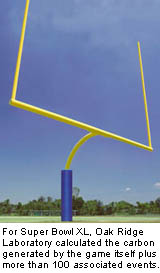
The National Football League held its second annual carbon-neutral Super Bowl in Detroit Sunday. Here is my article on the NFL's efforts to tackle environmental responsibility, published today in GreenBiz.com:


Greening the Gridiron


Categories: , ,

03 February 2006

Climate Change: Virtual March to Stop Global Warming


Readers of this blog know I am concerned about the climate crisis. In the 20th century, the world's average surface temperature rose by approximately 1 degree F. One degree may not sound like much -- really, do you notice the difference between 64 and 65 on your thermostat?

However, climate models now predict that higher concentrations of CO2 in the atmosphere will lead to a possible increase of 3-10 degrees F in the average surface temperature of the Earth.

That will lead to rising sea levels, melting polar ice caps, and more "perfect" storms. These changes have the power to change the nature of the places we care about, break the links in food chains and drive plants, animals, and people from their homes. It may even eradicate species like polar bears. I have said it before, I do not want to be responsible for the loss of polar bears. Do you?

The estimated costs of such "global warming" (a too-nice, comfy phrase for my taste) will have a devastating effect on human lives, especially the poor, but it could also affect your wallet through rising insurance costs and real property loss.

The prudent response to the climate crisis is to take actions to control emissions, adapt to impacts, and encourage scientific, technological, and socioeconomic research into the problem.

It is time to stop global warming by encouraging energy conservation, reducing our dependency upon fossil fuels, and calling for investments in new technologies that will help stem the rising tide

What can you do? Here's one thing: join me and 270,000 others on the "Virtual March," a creative idea started by StopGlobalWarming.org

Categories: ,

02 February 2006

Best Idea Since Sliced Bread: Polluter Pays

Peter Skidmore, an aquatic ecologist and restoration consultant with The Nature Conservancy in Washington State, is the winner of the "Since Sliced Bread" best common sense idea. Since Sliced Bread is "a national call for fresh, common sense ideas. A call for ideas that will strengthen our economy and improve the day-to-day lives of working men and women and their families."

His idea is to "Impose a 'resource tax' on pollution, development, and fossil fuel to pay for development of renewable energy and environmental restoration. Promoting sustainable localized energy industries (solar, wind, hydro, tidal, biofuels) will provide reliable, clean homegrown energy, exportable technologies, and bring energy jobs home. Funding widespread environmental restoration will expand existing industries (farming, recreation, tourism, and commercial fisheries) that are dependent on ecological services and will foster research, design and technology industries."

The "polluter pay" principle has been kicking around for some time. Essentially, it requires polluters to pay for the pollution they generate, thereby internalizing the true social cost of what they produce. Skidmore has translated this principle into a "common sense idea" worthy of note.

You can read more about his idea at Since Sliced Bread: Sustainable Resource Industries.

Categories: , , , ,

31 January 2006

Applaud President Bush For Courage in State of Union

Did you ever think you'd see the day? The former oil man and the industry's latest favorite friend, President Bush, calling for investments in alternative energy and a "Advanced Energy Initiative" in tonight's "State of the Union" address. But as I heard one pundit say after the broadcast, If Nixon can go to China in his second term, then I guess Bush can become a champion for alternative energy.

Here is a portion of the transcript from the White House website:

Keeping America competitive requires affordable energy. And here we have a serious problem: America is addicted to oil, which is often imported from unstable parts of the world. The best way to break this addiction is through technology. Since 2001, we have spent nearly $10 billion to develop cleaner, cheaper, and more reliable alternative energy sources -- and we are on the threshold of incredible advances.

So tonight, I announce the Advanced Energy Initiative -- a 22-percent increase in clean-energy research -- at the Department of Energy, to push for breakthroughs in two vital areas. To change how we power our homes and offices, we will invest more in zero-emission coal-fired plants, revolutionary solar and wind technologies, and clean, safe nuclear energy.

We must also change how we power our automobiles. We will increase our research in better batteries for hybrid and electric cars, and in pollution-free cars that run on hydrogen. We'll also fund additional research in cutting-edge methods of producing ethanol, not just from corn, but from wood chips and stalks, or switch grass. Our goal is to make this new kind of ethanol practical and competitive within six years.

Breakthroughs on this and other new technologies will help us reach another great goal: to replace more than 75 percent of our oil imports from the Middle East by 2025. By applying the talent and technology of America, this country can dramatically improve our environment, move beyond a petroleum-based economy, and make our dependence on Middle Eastern oil a thing of the past.

We'll be looking closely at the "Advanced Energy Initiative," for the details of his proposal. For now, we applaud President Bush for his courage in sticking his wildcatter's neck out by suggesting it's time to turn to market-based incentives for alternatives to oil dependency.


Categories: , ,

29 January 2006

BBC's "Planet Under Pressure"

I was talking with a friend this morning about the impacts of climate change and the question of what can be done about it. In sending him some background on the subject, I ran across this web site from the BBC.

The six-part series exploring "the planet's most pressing environmental problems." "Planet Under Pressure" ran some time ago in the UK (2004), but I don't know that it has been broadcast in the states. The site features a range of information, infographics, and evidence of change. Part six is devoted to the subject of climate change. Check out the animated guide, images of the impact, and the responses to environmental damage offered by teenagers.

Worth a look: BBC's "Planet Under Pressure"

Categories: , ,

26 January 2006

Peter Senge's Vision for an Interdependent Planet

Peter Senge, author of The Fifth Discipline, founding chair of the Society for Organizational Learning, and Systems Thinking guru, examines interdependence and, in an excerpt on the Pegasus web site, explains the facts of climate change using an elegant "stocks" and "flows" illustration. Worth a look (see link below):

In his keynote presentation at the 2005 Pegasus Conference, Peter Senge examined some of the factors that make it so hard for us to understand the complex interdependencies that connect us to each other. First, he suggested that the accelerated pace of change that we are living today has brought us to a place of unprecedented complexity where it is fair to say “we have never been here before.” Second, he observed that we simply have not fully developed our natural capacity to see the systems of which we are a part. And finally, he noted that we are challenged to expand our temporal and spatial horizons to see beyond the limits of our own perception to anticipate the impact and consequences of the choices we make.

Read the excerpt here: Senge on Interdependence

Categories: , ,