In a meeting I attended last week in Monterey, California, much of the talk centered on ecosystems services and how to account for them, how to factor them into the mix for conservation action, and their impact on the poor.
How curious to note, then, that only the week before, on the floor of the UN, the environment minister of Costa Rica was making similar comments and selling the concept to a group there gathered.
Maybe there is something in the air.
The concept of ecosystem services -- the life-sustaining properties and protection provided by nature -- has been kicking around for more than a decade. Only now, it seems to be getting some traction.
Countries like Costa Rica have unparalleled natural riches; this is undeniable. That we should economically quantify the contribution of such natural services as clean water from watersheds, flood and storm control from coastal wetlands and barrier islands, greenhouse gas reductions from forests and grasslands is not a new idea. But there is a new twist.
Where ecosystems services are concerned, it turns out the poorest are richest.
As The Economist (17 Sept 2005) says, "When natural accounts are expanded to include not only 'produced' wealth (goods and services), but also intangibles (such as knowledge) and especially natural wealth, they reveal some interesting patterns."
Now the World Bank and others, such as Carlos Manuel Rodriguez, that environment minister from Costa Rica, are calling for a new accounting to measure a country's economic welfare, a sort of "Green GDP," in the words of some.
It's been tried before, most notably in the macro-scale by Robert Constanza and other authors of a controversial Nature article a few years ago, but never (to my knowledge) on a country by country basis.
"If all environment ministers abandon tree-hugging in favor of such talk of profit and loss," The Economist notes, "Mr. Rodriguez's dreams may yet come true." That may be a long time coming, maybe too long to outrun the herd.
And there are still many a naysayer in the environmental community who would eschew any such valuing nature. They believe nature has "intrinsic value" and argue we should be altruistic in our efforts and our goals.
Wiser minds than mine have pointed out that "profit trumps altruism" every time. Maybe it's time to cede the bean counters the floor, and give profit a chance. Then the meek shall inherit the true wealth of nations.
Categories: conservation, poverty
28 September 2005


04 September 2005
A Ripple of Hope: Safe Drinking Water
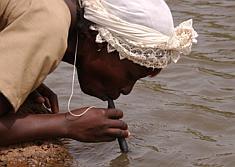
One of the UN Millennium Development Goals is to "reduce by half the proportion of people without sustainable access to safe drinking water" by the year 2015. Currently, more than one billion people do not have access to safe water and about half of the world's poor suffer from waterborne diseases. Over 6,000, mainly children, die each day by consuming unsafe drinking water.
Now a company called Vestergaard Frandsen, with branch offices in many developing countries, is pioneering a new product called the LifeStraw, which aims reduce the impact of waterborne diseases such as typhoid, cholera, dysentery, and diarrhea. The company specializes in disease control textiles and is the creator of the PermaNet, an insecticidal polyester mosquito bed net, and the ZeroFly shelter, an insecticidal plastic sheet that provides both shelter and malaria prevention for extreme emergency situations.
The LifeStraw turns surface water into drinking water as the drinker sucks in water from wherever she may be. Its simplicity is matched only by its effectiveness. It has a lifespan of 700 liters or about one year of water consumption for one person. The cost? The small plastic pipe filter runs around two bucks.
An article in MedGadget, "the internet journal of emerging medical technologies," describes the LifeStraw this way:
"What first meets the water when sucked up is a pre-filter of PE filter textile with a mesh opening of 100 micron, shortly followed by a second textile filter in polyester with a mesh opening of 15 micron. In this way all big articles are filtered out, even clusters of bacteria are removed. Then the water is led into a chamber of iodine impregnated beads, where bacteria, viruses and parasites are killed. The second chamber is a void space, where the iodine being washed off the beads can maintain their killing effect. The last chamber consists of granulated active carbon, which role is to take the main part of the bad smell of iodine, and to take the parasites that have not been taken by the pre-filter or killed by the iodine. The biggest parasites will be taken by the pre-filter, the weakest will be killed by the iodine, and the medium range parasites will be picked up by the active carbon. The main interest to everyone is the killing of bacteria, and here our laboratory reading tells us that we have a log. 7 to log 8 kill of most bacteria. This is better than tap water in many developed countries."
And the LifeStraw does all this for about the cost of a small bottle of "spring water" at your local airport newsstand!
More information: INDEX: The World Arena for Future Design and Innovation
Categories: conservation, water, poverty
03 September 2005
Story Telling as a Conservation Strategy
In the conservation community, when we talk about our work, we talk mostly about bucks and acres. We focus on how much land we protected, the species saved or how much money it took to do the deal.
What we leave behind is the back-story, which has more to do with the human communities affected by our work -- the families and individuals with ties to the lands and waters and the natural, life-sustaining services that provide their livelihood. There is always a story behind the scenes -- beyond the deal -- that is more compelling.
Several years ago, I learned about the work of Peter Forbes, who was spending a year or more as a fellow with his group, the Trust for Public Land. He spent much of that time examining their deals, looking for, and telling the back-stories. He gathered the stories, developing a method for ferreting them out of the muck. The result was The Story Handbook. I talked to Peter about his work several years ago at the annual Land Trust Alliance Rally and found an ally, someone whose thinking on the subject dwarfs mine.
My discipline in the conservation arena is fundraising; I've spent the last 14 years raising money from some wonderful people to protect places we care about together. I wanted to find a practical application for this thinking and a venue to test my assumptions. I'd been leading fundraising workshops for the Pennsylvania Land Trust Association over the years and approached them about an idea for a new workshop.
I called it "Telling Our Story: Connecting Place & People to Inspire Transformational Giving." I lead participants through an exercise in uncovering the back-story and bring it to the foreground. Really, it was about changing the nature of our conversations about conservation. I wanted the conversation to be more about the needs we fulfill, not about needs we have, and about what we can solve and what we can only serve. The idea was to focus on people, their values, and the impact we were having on issues and on people.
The participants had ten minutes to create their story, then pair off and tell it to a partner. Bringing them back together, I shared Forbes's "Story Sheets" concept from the Handbook, pulling out six essential points for a different kind of story telling:
The group then had to redraft their story along these lines, retell the story to their partner and then talk about what changed in their story, whether it was more compelling told in this way. The results were great; people told better stories in this new context. Moreover, their stories were less jargon-riddled and numbers oriented. They told real stories to which others could relate.
I went back to a couple of people in the organization I work for, The Nature Conservancy, and shared this idea. They latched onto it and took it further than I could ever imagine. The next thing I knew, we held a conference for fundraisers devoted to this concept of story telling. Peter Forbes was a keynote speaker and we passed out copies of The Story Handbook as required reading. Then one of our regions adopted the method, instructing their field-based staff in the art of telling their stories in a more personal and compelling way. Beautiful.
I continue to explore this vein, after afflicting the organization with this idea virus of story telling. Most recently, I have worked with a few colleagues to collect stories from the field and from partners and incorporate them into our toolbox for staff. Later this month we will publish a small book for a meeting in Monterey, Saving Our Seas: Stories of Marine Conservation. I'm excited about this effort and hope others will be.
People connect to stories; it is a tradition as old as human communication itself. We are a story telling species. Stories connect people to other people and to the lands and waters we protect. Like the songlines of the Aborigines, stories map a place in a way beyond symbols and geography. Stories are our way of connecting with each other and more broadly with the world. Think about it: when you get together with your friends, do you share stories?
If we're going to build a conservation ethic, we need to share our stories, to nurture a culture of story telling. We need to get at the heart of what makes our work relevant and important to people, to the future of our species and those with whom we share the earth, our island home.
What's your story?
Categories: conservation, stories
What we leave behind is the back-story, which has more to do with the human communities affected by our work -- the families and individuals with ties to the lands and waters and the natural, life-sustaining services that provide their livelihood. There is always a story behind the scenes -- beyond the deal -- that is more compelling.
Several years ago, I learned about the work of Peter Forbes, who was spending a year or more as a fellow with his group, the Trust for Public Land. He spent much of that time examining their deals, looking for, and telling the back-stories. He gathered the stories, developing a method for ferreting them out of the muck. The result was The Story Handbook. I talked to Peter about his work several years ago at the annual Land Trust Alliance Rally and found an ally, someone whose thinking on the subject dwarfs mine.
My discipline in the conservation arena is fundraising; I've spent the last 14 years raising money from some wonderful people to protect places we care about together. I wanted to find a practical application for this thinking and a venue to test my assumptions. I'd been leading fundraising workshops for the Pennsylvania Land Trust Association over the years and approached them about an idea for a new workshop.
I called it "Telling Our Story: Connecting Place & People to Inspire Transformational Giving." I lead participants through an exercise in uncovering the back-story and bring it to the foreground. Really, it was about changing the nature of our conversations about conservation. I wanted the conversation to be more about the needs we fulfill, not about needs we have, and about what we can solve and what we can only serve. The idea was to focus on people, their values, and the impact we were having on issues and on people.
The participants had ten minutes to create their story, then pair off and tell it to a partner. Bringing them back together, I shared Forbes's "Story Sheets" concept from the Handbook, pulling out six essential points for a different kind of story telling:
Describe the place from personal experience
State the context for the conservation project
Broader historical context
Larger Social Good Being Addressed
Relationships Strengthened and Preserved
Convey Emotion and Core Values
The group then had to redraft their story along these lines, retell the story to their partner and then talk about what changed in their story, whether it was more compelling told in this way. The results were great; people told better stories in this new context. Moreover, their stories were less jargon-riddled and numbers oriented. They told real stories to which others could relate.
I went back to a couple of people in the organization I work for, The Nature Conservancy, and shared this idea. They latched onto it and took it further than I could ever imagine. The next thing I knew, we held a conference for fundraisers devoted to this concept of story telling. Peter Forbes was a keynote speaker and we passed out copies of The Story Handbook as required reading. Then one of our regions adopted the method, instructing their field-based staff in the art of telling their stories in a more personal and compelling way. Beautiful.
I continue to explore this vein, after afflicting the organization with this idea virus of story telling. Most recently, I have worked with a few colleagues to collect stories from the field and from partners and incorporate them into our toolbox for staff. Later this month we will publish a small book for a meeting in Monterey, Saving Our Seas: Stories of Marine Conservation. I'm excited about this effort and hope others will be.
People connect to stories; it is a tradition as old as human communication itself. We are a story telling species. Stories connect people to other people and to the lands and waters we protect. Like the songlines of the Aborigines, stories map a place in a way beyond symbols and geography. Stories are our way of connecting with each other and more broadly with the world. Think about it: when you get together with your friends, do you share stories?
If we're going to build a conservation ethic, we need to share our stories, to nurture a culture of story telling. We need to get at the heart of what makes our work relevant and important to people, to the future of our species and those with whom we share the earth, our island home.
What's your story?
Categories: conservation, stories
02 September 2005
A Tragedy in the Deep South
This has been a troublesome week, as Katrina wrecks havoc on the Gulf Coast. Enviros and NeoCons start pointing fingers at each other over whether the severity of this storm has any relation to global warming. Meanwhile, the relief effort seems positively underwhelming and even Newt Gingrich questions the preparedness of our Homeland Security. While the loss of life and livelihoods pales in comparison to December's tsunami, it is still beyond comprehension.
Especially when it hits relatively close to home: my wife's family is from Gulfport, Mississippi, practically the epicenter of Katrina's impact. Her parents met there and were married for 57 years until her father died this past June. We were in Gulfport a couple of months ago for the funeral and burial. Someone told us the cemetery was now under water. All of her family, cousins and aunts and second cousins, are okay, but their homes have either been lost or suffered damage. While others watched their businesses wash out to sea.
The fact is rising water temperatures will lead to more hurricane forming conditions -- hurricanes feed on warm water, it's where they get their strength. But more to the point is the damage may have been lessened had the islands and wetland marshes along the coast survived the onslaught of development and levee construction. As Andrew Revkin and Cornelia Dean wrote in The New York Times this week, the barrier islands are the first line of defense for the coasts, marshes are the second.
"Maybe it's because of all those casinos," a resident of Biloxi said. The casinos and development all along the Gulf Coast has depleted the already degraded wetlands and marshes, which provide coastal protection and natural flood control. Louisiana Senator Mary Landrieu (D-LA) spoke of the importance of restoring her state's coast to its natural state. Louisiana is losing ground most significantly due to erosion and the diversion of Mississippi River silt from the Delta. Some estimates say the Louisiana Coast has shrunk by an amount equal to the size of Rhode Island since the 30s. And the EPA estimates that the Mississippi Delta Region has lost roughly 95 percent of its floodplain forest.
It's hubris to think that we can continue to build indiscriminately in these areas and that we can simply throw engineering solutions at flood control. It comes down to money and, as David Usborne wrote in The Independent yesterday, "In the battle between dollars and nature, you know who wins."
And once again, who suffers most from environmental degradation and the misuse of natural services? The poor, who can ill afford to lose the protection afforded by nature.
I am not about to pass judgment on anyone involved in the response, this was clearly an unprecedented event of a magnitude that we can only imagine. The logistics, even before victims started shooting at rescue helicopters and each other, were clearly complicated. All we can do is pray for the victims and hope for their recovery.
Yet, I can't help looking at the satellite images of Gulfport, where everything south of the railroad tracks is wiped out, and recalling the images from Aceh Province, Indonesia, and elsewhere of eight months ago. I have to wonder when we will wake up to the real benefits nature provides and stop letting dollars trump it every time.
Categories: conservation, climate, poverty
Especially when it hits relatively close to home: my wife's family is from Gulfport, Mississippi, practically the epicenter of Katrina's impact. Her parents met there and were married for 57 years until her father died this past June. We were in Gulfport a couple of months ago for the funeral and burial. Someone told us the cemetery was now under water. All of her family, cousins and aunts and second cousins, are okay, but their homes have either been lost or suffered damage. While others watched their businesses wash out to sea.
The fact is rising water temperatures will lead to more hurricane forming conditions -- hurricanes feed on warm water, it's where they get their strength. But more to the point is the damage may have been lessened had the islands and wetland marshes along the coast survived the onslaught of development and levee construction. As Andrew Revkin and Cornelia Dean wrote in The New York Times this week, the barrier islands are the first line of defense for the coasts, marshes are the second.
"Maybe it's because of all those casinos," a resident of Biloxi said. The casinos and development all along the Gulf Coast has depleted the already degraded wetlands and marshes, which provide coastal protection and natural flood control. Louisiana Senator Mary Landrieu (D-LA) spoke of the importance of restoring her state's coast to its natural state. Louisiana is losing ground most significantly due to erosion and the diversion of Mississippi River silt from the Delta. Some estimates say the Louisiana Coast has shrunk by an amount equal to the size of Rhode Island since the 30s. And the EPA estimates that the Mississippi Delta Region has lost roughly 95 percent of its floodplain forest.
It's hubris to think that we can continue to build indiscriminately in these areas and that we can simply throw engineering solutions at flood control. It comes down to money and, as David Usborne wrote in The Independent yesterday, "In the battle between dollars and nature, you know who wins."
And once again, who suffers most from environmental degradation and the misuse of natural services? The poor, who can ill afford to lose the protection afforded by nature.
I am not about to pass judgment on anyone involved in the response, this was clearly an unprecedented event of a magnitude that we can only imagine. The logistics, even before victims started shooting at rescue helicopters and each other, were clearly complicated. All we can do is pray for the victims and hope for their recovery.
Yet, I can't help looking at the satellite images of Gulfport, where everything south of the railroad tracks is wiped out, and recalling the images from Aceh Province, Indonesia, and elsewhere of eight months ago. I have to wonder when we will wake up to the real benefits nature provides and stop letting dollars trump it every time.
Categories: conservation, climate, poverty
22 August 2005
Make Poverty History: Protect the Safety Net
"Nature is the safety net of the poor," a colleague said last week.
What I think he meant by that is there are a range services nature provides upon which the Earth's one billion poorest people depend. From food production to flood control, from fuel for heating and cooking to traditional medicines, nature is the fabric that supports the poor and, ultimately, all of us.
Technology may be what drives the poorest to ascend the rung of the ladder of development, as Jeffrey Sachs suggests, but without nature's services, the poor would have nothing to fall back on. We need to protect those attributes most commonly found in the full range of biological diversity, while encouraging the most efficient means possible of getting the poor up that ladder.
Jon Christensen in "Forgive Us Our Debts" points out that "governance is the key word in international development." Good governance is just as important for biodiversity protection, whether we're talking protected areas or community conservation action. Governance, according to a recent release by the World Conservation Union (IUCN), includes "all the processes, traditions and rules that concur in establishing decisions, and should be based on principles like accountability, transparency, effectiveness and participation."
"Good governance is also a way of simultaneously expanding the conservation effectiveness of Protected Areas and their global coverage," said Ashish Kothari, co-chair of the IUCN's Theme on Indigenous and Local Communities, Equity, and Protected Areas, which is raising the awareness of existing governance tools.
When the Group of Eight agreed to forgive the debt of 18 of the world's poorest countries, Christensen writes, "they tied the debt relief to good government practices, improvements in health and education, and elimination of poverty."
Christensen notes the absence of the environment on that list. However, many of us believe the environment is intrinsically linked to those areas in need of improvement. Does it need to be called out? Possibly, but the effort to support the Millennium Development Goals through conservation measures is a step in the right direction. The time to ensure the equitable sharing of costs and benefits of biodiversity protection is at hand -- right next to the white wristband.
I agree with Christensen that sound governance "needs to be pushed further to embrace conservation of ecosystem services and biodiversity through good laws, adequate administration, and practical incentives that work for people on the land." We're talking not only governments here, but also communities and NGOs. Let's work toward that goal and, at the same time, revisit our conservation practices to encompass the needs of the communities in which we work -- be they global or local.
Categories: conservation, ecosystems, poverty
What I think he meant by that is there are a range services nature provides upon which the Earth's one billion poorest people depend. From food production to flood control, from fuel for heating and cooking to traditional medicines, nature is the fabric that supports the poor and, ultimately, all of us.
Technology may be what drives the poorest to ascend the rung of the ladder of development, as Jeffrey Sachs suggests, but without nature's services, the poor would have nothing to fall back on. We need to protect those attributes most commonly found in the full range of biological diversity, while encouraging the most efficient means possible of getting the poor up that ladder.
Jon Christensen in "Forgive Us Our Debts" points out that "governance is the key word in international development." Good governance is just as important for biodiversity protection, whether we're talking protected areas or community conservation action. Governance, according to a recent release by the World Conservation Union (IUCN), includes "all the processes, traditions and rules that concur in establishing decisions, and should be based on principles like accountability, transparency, effectiveness and participation."
"Good governance is also a way of simultaneously expanding the conservation effectiveness of Protected Areas and their global coverage," said Ashish Kothari, co-chair of the IUCN's Theme on Indigenous and Local Communities, Equity, and Protected Areas, which is raising the awareness of existing governance tools.
When the Group of Eight agreed to forgive the debt of 18 of the world's poorest countries, Christensen writes, "they tied the debt relief to good government practices, improvements in health and education, and elimination of poverty."
Christensen notes the absence of the environment on that list. However, many of us believe the environment is intrinsically linked to those areas in need of improvement. Does it need to be called out? Possibly, but the effort to support the Millennium Development Goals through conservation measures is a step in the right direction. The time to ensure the equitable sharing of costs and benefits of biodiversity protection is at hand -- right next to the white wristband.
I agree with Christensen that sound governance "needs to be pushed further to embrace conservation of ecosystem services and biodiversity through good laws, adequate administration, and practical incentives that work for people on the land." We're talking not only governments here, but also communities and NGOs. Let's work toward that goal and, at the same time, revisit our conservation practices to encompass the needs of the communities in which we work -- be they global or local.
Categories: conservation, ecosystems, poverty
10 August 2005
Conservationist, Nature Poet...Rock Star?
One of these things is not like the other. Can you guess which?
A few years ago, at a conference of nature writers and conservation practitioners, Barry Lopez told his audience that he felt "marginalized" as a writer. What he meant was that as a "nature writer" the literary establishment had sidelined him. A number of us rolled our eyes at that one; we would have given our left nut to be as marginalized as Barry Lopez. (Didn't he win the National Book Award for Arctic Dreams? He's a best-selling author, with a larger audience than many novelists!) My friend Bill from Alaska, said to me, "Wow, if Barry Lopez feels marginalized as a nature writer, how must you feel as a nature poet?!"
Bill had a point. I mean, can I be any more marginalized? Now, new reports about the environment dropping among issues of concern, the "death of environmentalism" debate, Michael Lewis' essay in the current issue of Poetry, and my wife's obsession with the reality show "Rock Star: INXS" have conspired to make me think, "You must revise your life!" (To quote an unkempt poet of some renown.)
Why is it so uncool to be a poet or an environmentalist? What is it that marginalizes these two ways of knowing and that alienates the general public? Why aren't there any rock stars in the conservation or poetry worlds? Or as Michael Lewis asks in his essay, "'Is there some new law that says a poet can't have sex appeal?'"
"I want to wash when I meet a poet," said Basil Bunting in his poem "What the Chairman Told Tom." Michael Lewis instructs poets to stop being so negative, that "nobody likes a whiner." He could have been talking to many greenies. In fact, much of Lewis' six-point "plan of attack" for poets would be well heeded by environmentalists: "Think Positive"; Pay Attention to the "Paying Customer"; "Think About Your Core Message"; "Strive to Be Relevant"; "Overcome Your Fear"; and "Think Bigger!"
My point is I think we in the movement need to reinvent ourselves. Turns out this is especially true for me, a "nature poet"; just thinking about it now, makes me want to grab a white shirt and black jeans from the closet , slap on some Beatle boots and hit the nightclub. I don't want to be a nature poet or a crunchy-granola conservation geek. We need some rock stars.
One colleague of mine is a smart-looking Brit who clearly shops at the right tailors in London whenever he gets back home. He looks sharp. He does not conform to the male uniform of the organization we both work for and that of the movement at large: blue oxford cloth shirt, khakis and brown loafers. One day I told him, "Nigel, you're looking great. You look like a pop-star not like someone who works for a nature group." He held out his hands, weighing the two as if they were scales of justice: "'Pop star'; 'Nature Group,'" he said. "Hmmm, I'd rather..." I don't have to tell you how he answered.
I used to be a rock star. Well, okay, a small-time rock star. Under the name Dash Beatcomber, I sang lead and played bass in a band for about five or six years in the late seventies-early eighties. The band had various incarnations, among them Deadpants and Active Driveway; we even had our own label "Sorry Kitten Records" and our own magazine Rockstop!. We went through a punk phase, a post-punk phase, even a Europop phase and were, at the end of our lifespan, among the original grunge and alt-country outfits.
We were cool, we were hip, we had seasons in the sun – actually, out of the sun, working on that trademark pallor of the rock star. Our recordings got airplay on WFMU, WFUV, and other cool NYC alternative stations. Our biggest claim to fame was opening for a then on-the-brink-of-being famous new wave band. (We were one of several acts on the bill; I said we were small-time). Jan & Dean had planned to record our song "Surf Ohio," which I’d written in a Dunkin' Donuts in upstate New York, but then they 86'd their comeback album.
What happened to us? Like many garage bands, we burned out. I moved to Europe; we all moved on with our lives. Our last recording session – now lost – included a couple of songs. One that I wrote with our guitarist Joshu called "Blondes on Bikes," a sort of alt-country paean to summer romance and Dylan's "It Takes a lot to Laugh, It Takes a Train to Cry." I did a killer harmonica solo on that one. When I told this story to my wife after playing Dylan's version on the jukebox in a bar the other night, she said, "It's probably best the tape is lost." (Somewhere out there is a cache of recordings of Active Driveway that would prove my point about at least one thing: we were ahead of our time. Okay, two things: we were small-time and ahead of our time.)
Those were the glory days, as the Boss says, when I used to be cool. Now, according to some recent reports in the media, I find that I have one foot in each of two "loser" camps, poetry and conservation. Moreover, I've spent the better part of the last twenty years trying to bring those two worlds together in my work and life. Who advised that? Now there's no chance that I can make a comeback as a rocker in my forties – comeback from what? Can one come back from virtual obscurity?
This is where my wife comes in. She's been watching (okay, I'll admit, I have too) this new reality show where a group of singers compete to lead the band INXS. I began to wonder what it would be like to be one of the competitors. Would I still have my rock 'n' roll moves? Could I still make a crowd get up and scream not just get up and scram? These days, my only performances are either in front of a PowerPoint screen, behind a podium in a bookstore, or in my living room in front of my two year old twins.
At heart, I'm concerned about being more marginalized than Barry Lopez. I don't want to be Barry Lopez, I just don't want to feel like I have my feet in a pair of loser boots. How do we expect to compete with stuff like "Rock Star: INXS"? I mean, INXS were not that groundbreaking a band and they have millions of viewers tuning in to this stuff. The closest thing we have in the environmental world is Jeff Corwin on "Animal Planet." There's got to be more. And poetry? The most popular poet in America today is Billy Collins. Have you seen him? A decidedly un-sexy fellow.
I say all this not because I'm suffering from some mid-life crisis—okay, maybe a little one—but because I think it's all connected to the fact that the environment is slipping on the list of issues that reach people. (I'm not the first to notice the similarities between "The Death of Environmentalism" and "Can Poetry Matter?" Dana Gioia's 1991 essay that spoke of elitism and insularity in the poetry world.) Poetry, at least Spoken Word poetry, has certainly made a more public splash these past few years, but for the most part, people are not turning to poems for inspiration and truth anymore. They are turning to rock stars. And do they care about the environment? Apparently, not as much as they do about who the latest "Survivor" is.
How can we expect to connect with people on this level? How can we get them to understand the links between where they live, the lifestyle they choose, and the future of our existence? Will they care the way they care about all these Janes and Joes trying to make it big on the small screen? After all, you can't "Text-Message" your vote for the environment like you can for Suzie, Ty, or Marti. But why not? Send a text message to Rockstar:INXS vote for ECODASH05
Categories: conservation, ethic
A few years ago, at a conference of nature writers and conservation practitioners, Barry Lopez told his audience that he felt "marginalized" as a writer. What he meant was that as a "nature writer" the literary establishment had sidelined him. A number of us rolled our eyes at that one; we would have given our left nut to be as marginalized as Barry Lopez. (Didn't he win the National Book Award for Arctic Dreams? He's a best-selling author, with a larger audience than many novelists!) My friend Bill from Alaska, said to me, "Wow, if Barry Lopez feels marginalized as a nature writer, how must you feel as a nature poet?!"
Bill had a point. I mean, can I be any more marginalized? Now, new reports about the environment dropping among issues of concern, the "death of environmentalism" debate, Michael Lewis' essay in the current issue of Poetry, and my wife's obsession with the reality show "Rock Star: INXS" have conspired to make me think, "You must revise your life!" (To quote an unkempt poet of some renown.)
Why is it so uncool to be a poet or an environmentalist? What is it that marginalizes these two ways of knowing and that alienates the general public? Why aren't there any rock stars in the conservation or poetry worlds? Or as Michael Lewis asks in his essay, "'Is there some new law that says a poet can't have sex appeal?'"
"I want to wash when I meet a poet," said Basil Bunting in his poem "What the Chairman Told Tom." Michael Lewis instructs poets to stop being so negative, that "nobody likes a whiner." He could have been talking to many greenies. In fact, much of Lewis' six-point "plan of attack" for poets would be well heeded by environmentalists: "Think Positive"; Pay Attention to the "Paying Customer"; "Think About Your Core Message"; "Strive to Be Relevant"; "Overcome Your Fear"; and "Think Bigger!"
My point is I think we in the movement need to reinvent ourselves. Turns out this is especially true for me, a "nature poet"; just thinking about it now, makes me want to grab a white shirt and black jeans from the closet , slap on some Beatle boots and hit the nightclub. I don't want to be a nature poet or a crunchy-granola conservation geek. We need some rock stars.
One colleague of mine is a smart-looking Brit who clearly shops at the right tailors in London whenever he gets back home. He looks sharp. He does not conform to the male uniform of the organization we both work for and that of the movement at large: blue oxford cloth shirt, khakis and brown loafers. One day I told him, "Nigel, you're looking great. You look like a pop-star not like someone who works for a nature group." He held out his hands, weighing the two as if they were scales of justice: "'Pop star'; 'Nature Group,'" he said. "Hmmm, I'd rather..." I don't have to tell you how he answered.
I used to be a rock star. Well, okay, a small-time rock star. Under the name Dash Beatcomber, I sang lead and played bass in a band for about five or six years in the late seventies-early eighties. The band had various incarnations, among them Deadpants and Active Driveway; we even had our own label "Sorry Kitten Records" and our own magazine Rockstop!. We went through a punk phase, a post-punk phase, even a Europop phase and were, at the end of our lifespan, among the original grunge and alt-country outfits.
We were cool, we were hip, we had seasons in the sun – actually, out of the sun, working on that trademark pallor of the rock star. Our recordings got airplay on WFMU, WFUV, and other cool NYC alternative stations. Our biggest claim to fame was opening for a then on-the-brink-of-being famous new wave band. (We were one of several acts on the bill; I said we were small-time). Jan & Dean had planned to record our song "Surf Ohio," which I’d written in a Dunkin' Donuts in upstate New York, but then they 86'd their comeback album.
What happened to us? Like many garage bands, we burned out. I moved to Europe; we all moved on with our lives. Our last recording session – now lost – included a couple of songs. One that I wrote with our guitarist Joshu called "Blondes on Bikes," a sort of alt-country paean to summer romance and Dylan's "It Takes a lot to Laugh, It Takes a Train to Cry." I did a killer harmonica solo on that one. When I told this story to my wife after playing Dylan's version on the jukebox in a bar the other night, she said, "It's probably best the tape is lost." (Somewhere out there is a cache of recordings of Active Driveway that would prove my point about at least one thing: we were ahead of our time. Okay, two things: we were small-time and ahead of our time.)
Those were the glory days, as the Boss says, when I used to be cool. Now, according to some recent reports in the media, I find that I have one foot in each of two "loser" camps, poetry and conservation. Moreover, I've spent the better part of the last twenty years trying to bring those two worlds together in my work and life. Who advised that? Now there's no chance that I can make a comeback as a rocker in my forties – comeback from what? Can one come back from virtual obscurity?
This is where my wife comes in. She's been watching (okay, I'll admit, I have too) this new reality show where a group of singers compete to lead the band INXS. I began to wonder what it would be like to be one of the competitors. Would I still have my rock 'n' roll moves? Could I still make a crowd get up and scream not just get up and scram? These days, my only performances are either in front of a PowerPoint screen, behind a podium in a bookstore, or in my living room in front of my two year old twins.
At heart, I'm concerned about being more marginalized than Barry Lopez. I don't want to be Barry Lopez, I just don't want to feel like I have my feet in a pair of loser boots. How do we expect to compete with stuff like "Rock Star: INXS"? I mean, INXS were not that groundbreaking a band and they have millions of viewers tuning in to this stuff. The closest thing we have in the environmental world is Jeff Corwin on "Animal Planet." There's got to be more. And poetry? The most popular poet in America today is Billy Collins. Have you seen him? A decidedly un-sexy fellow.
I say all this not because I'm suffering from some mid-life crisis—okay, maybe a little one—but because I think it's all connected to the fact that the environment is slipping on the list of issues that reach people. (I'm not the first to notice the similarities between "The Death of Environmentalism" and "Can Poetry Matter?" Dana Gioia's 1991 essay that spoke of elitism and insularity in the poetry world.) Poetry, at least Spoken Word poetry, has certainly made a more public splash these past few years, but for the most part, people are not turning to poems for inspiration and truth anymore. They are turning to rock stars. And do they care about the environment? Apparently, not as much as they do about who the latest "Survivor" is.
How can we expect to connect with people on this level? How can we get them to understand the links between where they live, the lifestyle they choose, and the future of our existence? Will they care the way they care about all these Janes and Joes trying to make it big on the small screen? After all, you can't "Text-Message" your vote for the environment like you can for Suzie, Ty, or Marti. But why not? Send a text message to Rockstar:INXS vote for ECODASH05
Categories: conservation, ethic
Subscribe to:
Posts (Atom)